
Automobile retail sales rose nearly 18 per cent year-on-year to over 27 lakh units in January, led by continued post-GST momentum, healthy rural cash flows on the back of harvest and weddings, and sustained demand visibility across freight, dealer's body FADA said on Tuesday.

Though it will tackle the tangled web of permissions required for a project, a bottom-up approach would be more effective.

Stepped up public expenditure must be accompanied by focused policies, advises Vinayak Chatterjee.
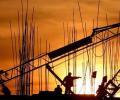
Whilst substantive public allocations have been made in the infrastructure sector, this strategy is plateauing due to the fiscal deficit constraint, capacity limitation of statal implementing agencies, the declining ability of PSUs, and the precarious situation of the Railways' operating ratio. It is, thus, high time to get the policy compass to point at rejuvenating private sector investments in infrastructure, says Vinayak Chatterjee.

Infra sector is neglected by the Modi govt.

Modi govt must bring about reforms to kick-start big-ticket infra projects.

Sensex, Nifty under pressure on weak global cues.
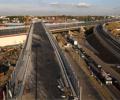
With buyers playing safe, projects such as Delhi-Gurgaon Expressway find it difficult to get new concessionaires

Little attention is being paid to keep roads, bridges and flyovers in good shape

Funds raised by India Inc. through offshore loan syndication hit a 15-year high in 2023 with companies and banks raising $21.4 billion, the highest since 2007. The momentum is expected to continue in 2024 as well with over $4 billion fund raising expected in the first three months of this year. Companies raise funds, both onshore and offshore, depending on interest rates and activities. Funds raised offshore can be deployed in overseas activities.

Yes. Whilst public expenditure is kicking in, the key reason is the decline in private investment
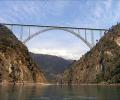
To attract capital into infrastructure projects, the ratings system needs a fresh look.

rediffGURU Ashwini Dasgupta offers advice on what you can do to grow in your career and shine at the workplace.

Railways, rural infrastructure, urban rejuvenation, solar and transmission and distribution of electricity are the new priorities, says Vinayak Chatterjee.

As the Centre pushes reforms in the power sector, especially for the beleaguered electricity distribution segment, several states, especially those ruled by Opposition parties, are clamouring against it. Maharashtra, West Bengal, Tamil Nadu, and Kerela have voiced their reservations against the proposed amendments to the Electricity Act, 2003. The irony is the states opposing the amendments on the ground of threat of privatisation already have private partnerships in power supply. The proposed Bill was slated to be placed on the floor of Parliament in the Monsoon session. But it still awaits Cabinet approval amid several states complaining that they have been not consulted on the issue.

Steps are needed at granular level to boost investment in infrastructure, says Vinayak Chatterjee.

The results are likely to please the Indian government, which has been trying to impress on domestic and foreign investors about its efforts to improve the ease of doing business.

There are both positive and negative impacts of the tax, but the net result for India's infrastructure sector is advantageous, says Vinayak Chatterjee.

It is a national economic problem and one that requires a political solution hand in hand with a clear government commitment to stand behind core national assets, says Vinayak Chatterjee.
Following Hyderabad-based GMR Infrastructure's successful bid for the new Istanbul airport and DS Construction's acquisition of energy company Globeleq's US assets, many mid-size infrastructure companies are planning to venture overseas.

Industry chamber Ficci has sought details from the government about the "actual progress" of the mega infrastructure projects cleared by Cabinet Committee on Investment.

The overriding objective of the National Investment and Infrastructure Fund (NIIF) must be adequate economic return, not financial return.

Can the newly-minted Jal Shakti ministry bring water to some 19 crore Indian households that have never had taps or heard the sound of flowing water, wonders Vinayak Chatterjee.

From Kudankulam to the Land Bill, the author takes the Twitter route to capture the infra action of 2013.

Private sector firms need to be re-engaged for better infra planning.

To cover most of the gap, the road ministry plans to raise $7 billion.

Smart cities must be very well equipped with technology and security systems alike.
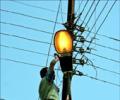
Power plant load factors are at historic lows of around 60 per cent.
The housing finance regulator National Housing Bank on Thursday said it was collecting information from housing finance companies about their exposure in group entities of the scam-tainted Satyam Computer Services.

Indian roads are far more unsafe than its railways. A sense of urgency is required to tackle India's embarrassing record on road safety.

Experts believe modifying the placement model is a good decision given the changes that campus recruitment has undergone globally, says Vinay Umarji.

'We never go overboard on any stock, no matter how good it may seem.'

Union Railway Minister Suresh Prabhu aligns priorities, funding and organisation to shape a transformation agenda.

The real estate Bill will stamp out illegal practices prevalent in the industry.

Hard and unpopular decisions are needed - not just another round of financial repackaging to sort out the discom mess.

The nation wants an ex-ante body for endorsing "public purpose" during land acquistion process.

Omkeshwar Singh, head, Rank MF, a mutual fund investment platform, answers your queries.

Ajit Mishra, vice president, Research, Religare Broking, answers your queries.

This uncaring attitude is primarily based on the fact that road concessionaires still do not see themselves as "service deliverers", says Vinayak Chatterjee.
If nothing is done, the country is set to become 83 per cent energy-import-dependent by 2040.
